
Gear & equipment
Retractable leashes: the honest case against
We understand the appeal. A retractable leash promises freedom for the dog and convenience for you, all in one plastic handle. In practice it hands control to a spring and a thumb button, and it rewards the exact behaviour many owners want gone. This is the honest case against them, and what we put in a client's hand instead.
Last reviewed October 4, 2026
Three real problems
Burns, late braking and a pull that pays.
The cord or thin tape is the first problem. If it wraps around a hand, a leg or another dog, a running dog can pull it tight fast enough to burn or cut skin. Grabbing the line to stop a dog is a reflex, and it is exactly the wrong move. A bulky handle dropped mid-walk can also clatter after a dog and frighten it further.
The second problem is control that arrives late. Your dog can be well ahead at a driveway or crosswalk before the brake engages. The third is quieter: the spring keeps steady tension on the collar, so a dog learns that pulling is how the line gets longer. That habit then follows you onto every other leash you own.
- Cord can burn hands and legs
- Brake engages after the moment
- Constant tension rewards pulling
- Dropped handles can chase dogs
Better tools instead
What to use for each job a retractable claims.
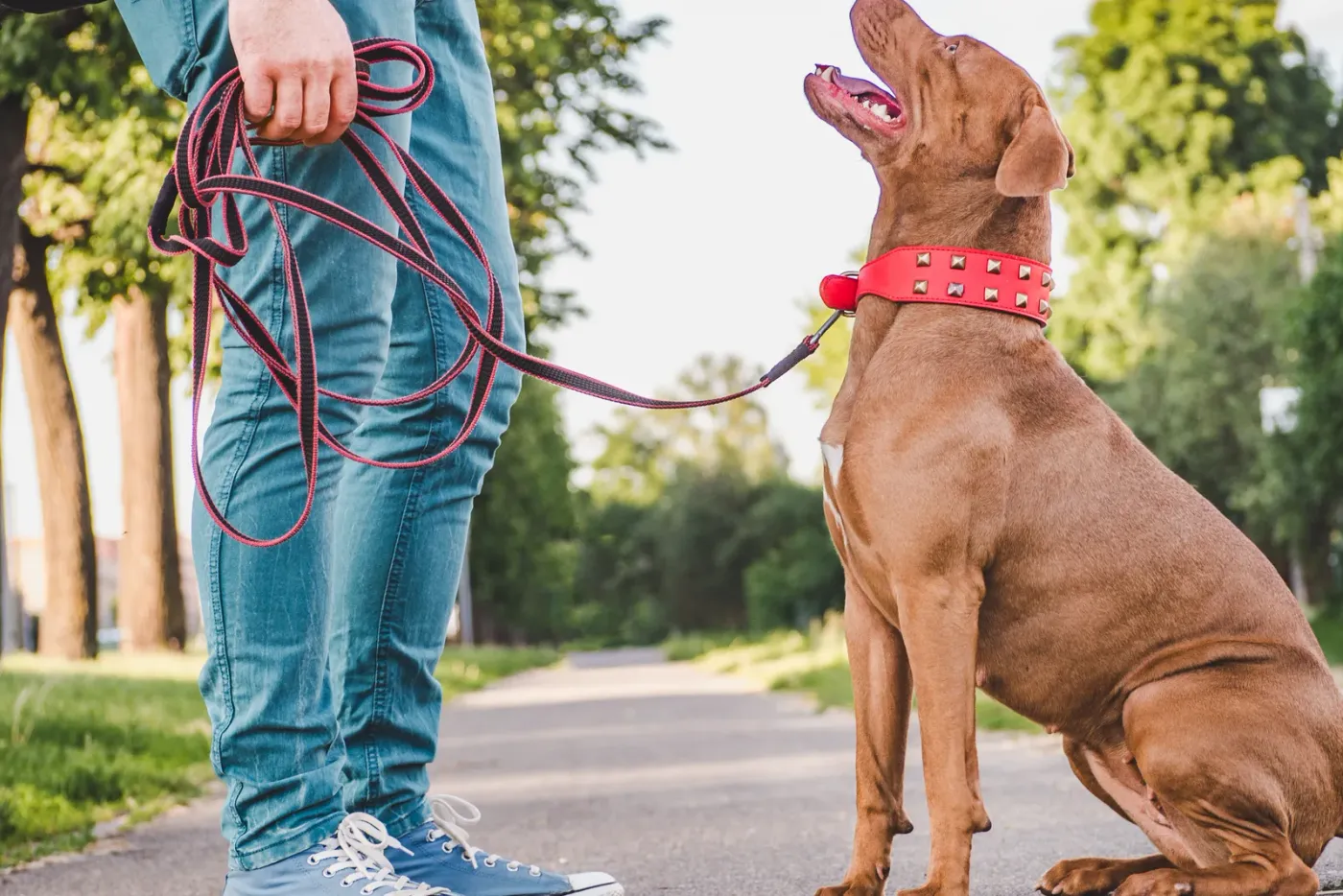
For city walks, a fixed four- or six-foot leash gives a known length and a clear signal: slack means walking with you, tension means stop. For sniffing time, give a deliberate release on a standard leash in a safe spot. For recall and distance practice, use a long line in open space, held and handled properly, never left to drag near traffic.
If you already own a retractable, lock it at a short length and use it only where there are no roads, bikes or leashed dogs, or retire it. Our On-Leash Foundations and Puppy Fundamentals programs include a slip lead and training collar to take home, and every tool is taught to the owner, so you know exactly how to use it.

Undoing the pull
Switching a spring-trained dog to a fixed leash.
Dogs used to a spring often surge to the end of a normal leash and hit it hard. Start somewhere calm, stop the moment the leash goes tight, and move again when it softens. Mark and reward your dog for being at your side. Pulling may temporarily increase while the old rule stops paying, so keep the rule the same every time.
If your dog lunges at other dogs, bikes or people, treat that as more than a leash habit. Management comes first: more distance, quieter routes, and a collar your dog cannot back out of. A professional assessment is the right next step when lunging persists or escalates, and a Private Training session at $150 + GST is one place to start.
Asked and answered
The questions people ask us.
Why do trainers dislike retractable leashes?
Mostly because of control and habit. The length changes without warning, braking depends on a small button, and constant spring tension teaches many dogs that pulling earns room.
Can a retractable leash hurt you?
It can. The thin cord can burn or cut skin if it wraps around fingers or legs, and a sudden lunge can wrench the hand holding the handle. Never grab the line to stop a dog.
Are retractable leashes okay for small dogs?
Size does not change the problem. A small dog at the end of a long cord can still reach a road, a bigger dog or a bike before you react. A light fixed leash tends to serve small dogs better.
Is a long line the same as a retractable leash?
No. A long line is a fixed-length training tool with no spring, so there is no constant tension and you decide how much line your dog has. It is meant for open space, not sidewalks.
Keep reading
Retire the spring
Book a consultation and we will watch how your dog walks, then recommend the smallest program that covers it.
From real owners
Rated 5.0 on Google.
Real Northline dogs