
Adventure dogs
Canoeing and kayaking with a dog
On a paddleboard, a restless dog costs you your balance and a swim. In a canoe, restlessness puts the gunwale under water and everything you packed on the bottom of the lake. The margin is smaller, the sides are higher, and you cannot step off to steady things. So the training asks for more: a down that is boring to the dog, and an entry so calm it looks rehearsed. Because it is.
Last reviewed October 4, 2026
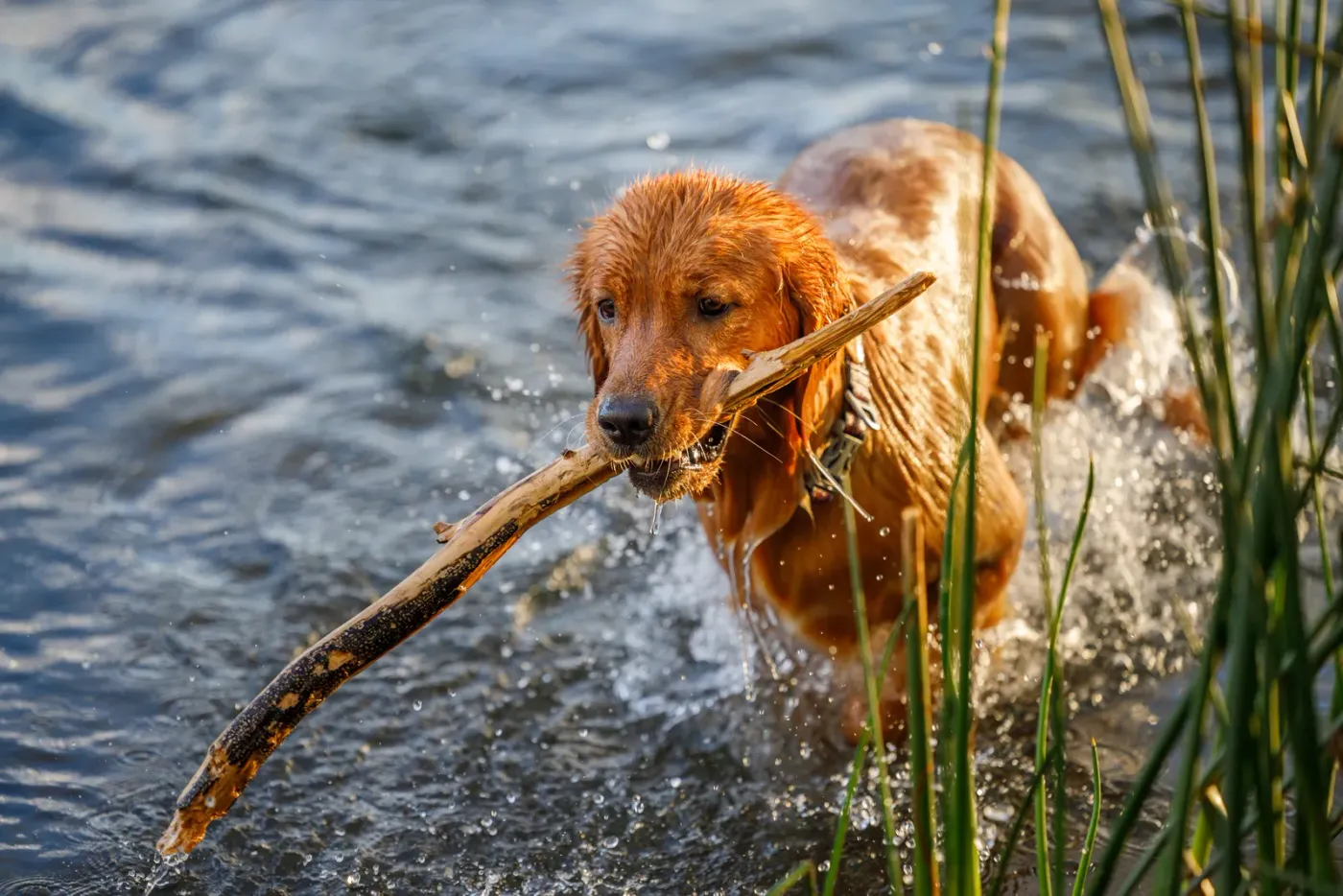
Three non-negotiables
The down, the step in, and the splash that means nothing.
Management first: the dog wears a flotation vest with a handle along the back, an adult holds the leash while loading, and the boat is beached and steadied in shin-deep water before the dog is asked to step in. The dog is never tied to a thwart or seat. If the boat goes over, a tethered dog goes under it. Put a non-slip mat on the floor so claws grip something other than a wet hull.
The down is the core skill. In a canoe the dog lies amidships on the mat, low and centred; in a kayak they settle between your knees or on the front deck, depending on the boat. Build it so a paddle drip, a jumping fish or a calling loon changes nothing. Pair the down with a leave it taught on land, aimed at the things a boat produces: splashes beside the hull, ripples from the blade, and birds lifting off the water.
- Flotation vest with a back handle
- Boat steadied in shin-deep water
- Never tethered to thwart or seat
- Non-slip mat on the hull floor
Before the lake
Rehearse in a boat that is going nowhere.
Set the canoe or kayak on the lawn, propped so it cannot roll, and run the sequence dry: step in, down on the mat, stay while you climb in behind, pick up the paddle, swing it over the dog's head, set it down, step out. Then do it in the shallows with the boat steadied by a second adult. Only then paddle, and only on a lake. Current removes your ability to stop, turn and go back for a dog who has gone in.
Portages and landings are where recall earns its keep. A dog who bolts up the trail the moment the hull touches gravel, or leaps out early and swims for the beach, needs to come back to one call with your hands full. Practise that recall at the landing on a long line first. Be honest about the dog who should stay home: the one who lunges at every splash or panics when the boat rocks. A lake is a poor place to find out.
Asked and answered
The questions people ask us.
What training does a dog need before canoeing?
A down-stay that holds for the length of the trip, a calm step in and out of a steadied boat, a leave it for splashes and birds, and a recall that works at the landing. Rehearse all of it in the boat on your lawn before it ever floats. The boat should be the least interesting place the dog has ever been.
Any tips for kayaking with a dog?
Fit the dog with a flotation vest that has a handle, position them between your knees or on the front deck depending on the hull, and start on a flat lake with no wind. Keep the first paddles short and end them before the dog gets restless. A kayak's low sides mean a dog can step out at will, so the down matters more, not less.
How do you keep a dog calm in a canoe?
Calm in the boat is built on land, with a down on a non-slip mat that gets rewarded for lasting through paddle drips, rocking and you shifting your weight. Give the dog nothing to do but lie there, and reward that generously. If the dog cannot settle in the boat on the grass, they will not settle on the water.
Can a dog go on a river in a kayak?
Not at first. Moving water keeps the boat travelling while you deal with a dog who has gone in, and eddies and sweepers add hazards a lake never has. Learn on flat water with no wind, and treat a river as a later step once the down and the recall are proven.
Keep reading
Make the boat boring
A dog who can settle in a canoe on the lawn is ready to try the lake. Book a consultation to build it.
From real owners
Rated 5.0 on Google.
Real Northline dogs