
Straight answer
Why is my dog reactive on leash but not off?
Plenty of owners live with this exact contradiction: a dog that plays politely at the off-leash park, then screams at the same dogs from the end of a six-foot lead. It looks like a personality disorder. It is actually geometry. Clip on a leash and you change what your dog can do about discomfort, and that change explains nearly all of the noise.
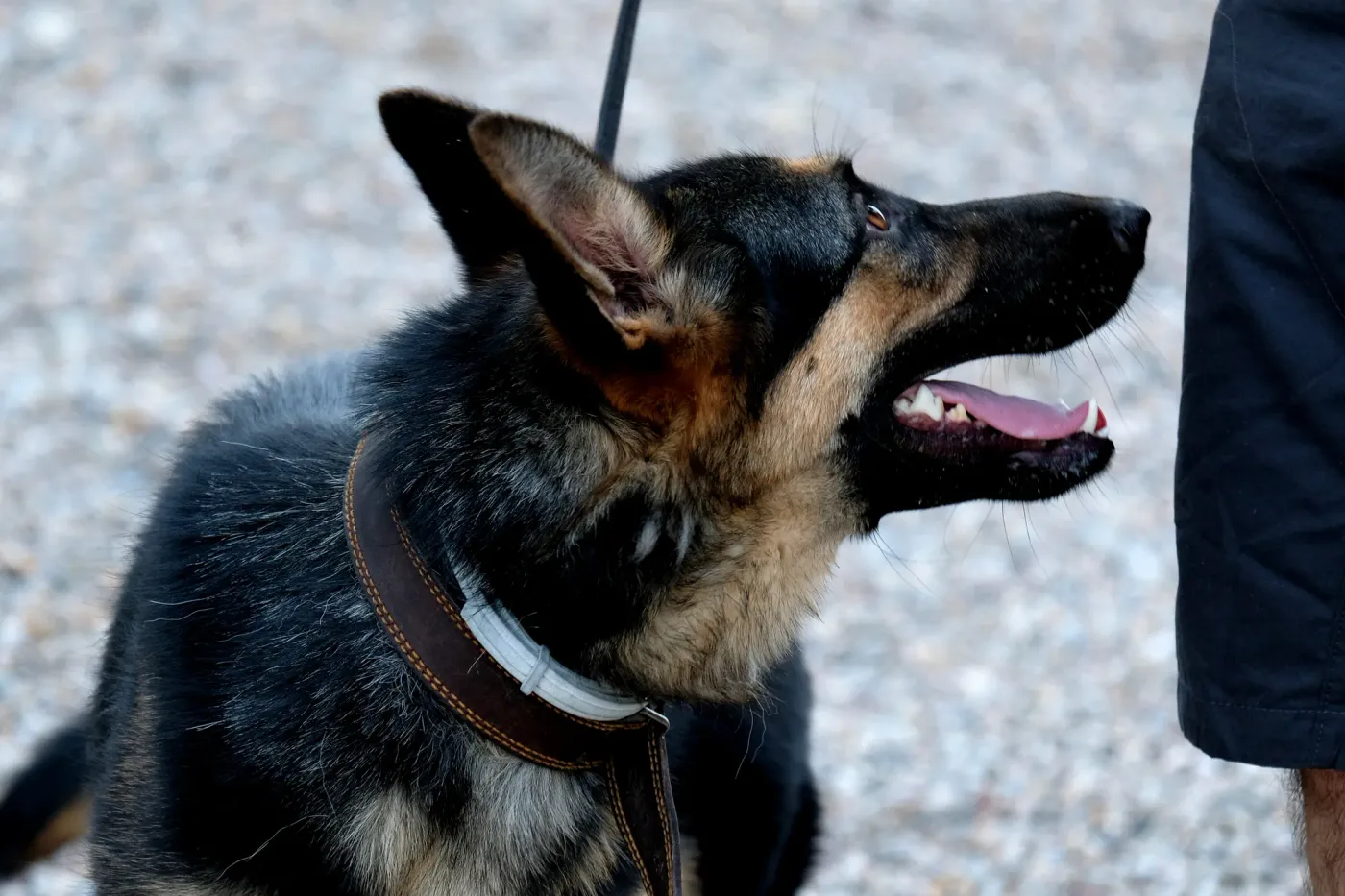
The trapped feeling
The leash takes away your dog's exits.
Off leash, a dog manages social situations with movement. It approaches in a curve, sniffs, drifts off when it has had enough, and puts space between itself and anything unsettling. Distance is the whole toolkit. On leash, every one of those moves is gone: no arcing, no retreating, no choosing the pace of an approach. The dog is locked on a straight line toward whatever worries it, and barking becomes the only lever left to pull.
Two accelerants finish the picture. Barrier frustration: for a social dog, the leash blocks the greeting it wants, and blocked wanting curdles into noise remarkably fast. And tension: the moment you spot another dog, you shorten the lead, and that pressure travels straight down the line as an announcement that something is wrong. Your dog reads it, matches it, and the display starts before you have crossed the street.
- Distance is a coping tool
- Leashes block natural greetings
- Tension travels down the line
- Friendly off leash, loud on
What it means
Train the feeling, not the bark.
This diagnosis changes the treatment. The problem is not the other dog; it is how being trapped near one feels. So the work targets the emotion: starting far from other dogs, pairing their appearance with things your dog loves, and teaching a check-in with you that reliably earns more space. Done well, the sight of a dog stops predicting confinement and starts predicting payoff. Obedience gives the walk structure, but the feeling is what gets retrained.
This is also why punishing the barking backfires. Leash corrections during a reaction confirm the dog's working theory: other dogs appearing while trapped makes bad things happen. The display may get quieter while the dread underneath gets louder, which is a worse trade than it looks. The good news sits on the other side: leash reactivity is one of the most common problems we see, and one of the most reliably improvable, because the emotion driving it responds so well to structured work.
The programs
The behaviour-first formats.
Assessment before plan, thresholds before pressure. These programs run that way.
W · One-hour session
Private Training
One-on-one coaching with you on the other end of the leash.
Includes a written weekly plan to work from
S · 5–6 week board & train
Behaviour Rehab
Kaitlin's specialty, and the work she loves most.
Includes assessment-built plan, 2 follow-ups, deep owner education
Asked and answered
The questions people ask us.
Why is my dog reactive on leash but fine at daycare?
At daycare your dog can move: approach, retreat, and take breaks on its own schedule. On leash, all of that control disappears while the trigger keeps approaching. Same dog, same social skills, completely different set of options.
My dog is fine off leash but reactive on leash. Is that normal?
It is one of the most common patterns in reactivity, and arguably the most misunderstood. It usually signals frustration or trapped discomfort rather than genuine aggression. That distinction matters, because the training plan for a frustrated greeter differs from one for a fearful dog.
Should I correct my dog for barking and lunging at other dogs?
Corrections in the middle of a reaction tend to deepen the problem, because the dog links the discomfort to the other dog's appearance. You get a quieter dog with a worse opinion of dogs. Change what the trigger predicts first; polish behaviour second.
Can leash reactivity be fixed or just managed?
Most leash-reactive dogs improve substantially with structured training, to the point where walks are genuinely relaxed. The emotion driving the display is retrainable at any age. How far a particular dog can go is something an assessment answers better than a webpage.
Keep reading
Make walks quiet again
Leash reactivity responds well to one-on-one work. Book a consultation and describe what your walks look like right now.
From real owners
Rated 5.0 on Google.
Real Northline dogs