
Adventure dogs
Distance commands: what they are and why they matter off leash
The off-leash conversation is mostly about recall, and recall is the foundation. But there is a moment recall cannot fix: your dog is fifty metres away on the wrong side of a trail, a horse and rider are coming between you, and calling him means he crosses in front of the horse. What you need there is a word that stops him where he stands. That is a distance command.
Last reviewed October 4, 2026
Three situations
A stop ends the chase before the recall starts.
Picture a deer breaking cover thirty metres ahead. The dog has a half-second head start, and recall is a request to turn around mid-sprint, which is about the hardest thing to ask of a chasing dog. A down, delivered the instant the dog's ears lock on, asks for something easier: stop moving. Once the dog is down and the deer is gone, the recall is routine. The order matters. Stop first, then come.
The horse and the water work the same way. A dog on the far side of a trail with riders approaching should stay put until they pass; calling him brings him across hooves. A dog trotting toward a spring creek running high needs to hear sit before his feet are wet, because recall from midstream is a swim he may not win. In all three the dog is safest exactly where he is, and only a distance command can keep him there.
- Sit where the dog stands
- Down from fifty metres
- Stop before the recall
- Hold while riders pass
Building distance
The walk-in is the failure to train against.
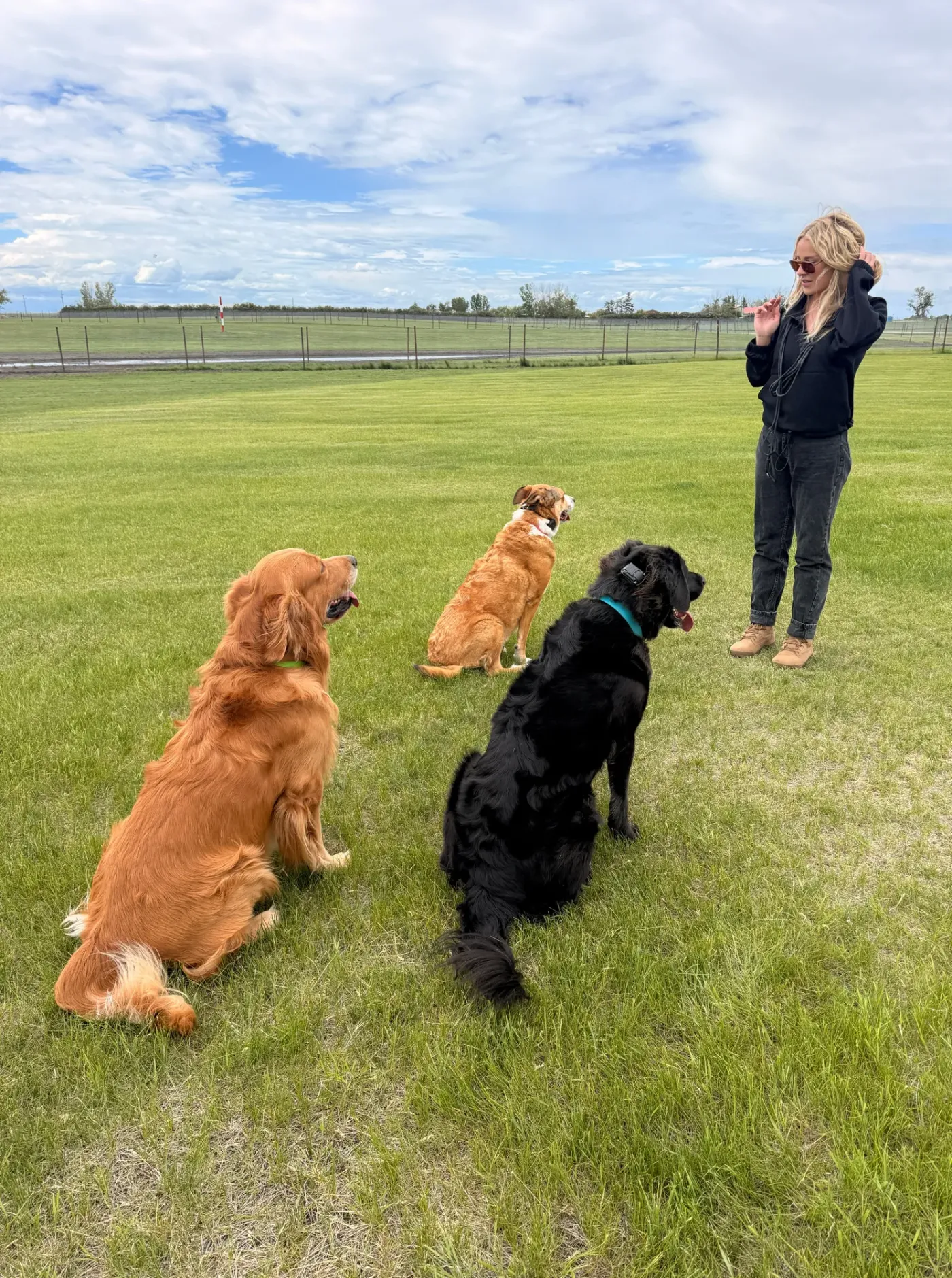
Distance is its own skill. A dog who sits at your knee often does not know what sit means from ten metres, and the usual failure is the walk-in: he hears the cue and trots to you before sitting. Advanced Off-Leash lists sit, stay and down at distance in its four weeks. We teach the position with a marker and reward first, then back away one stride at a time, delivering the reward to him where he is, so staying put is what pays.
Distance tends to erode, because owners stop asking for it once the dog seems reliable. Run a two-minute drill on ordinary walks: cue a sit when the dog is twenty metres ahead, walk to him, pay, release. Sometimes cue it while he is trotting away, since a dog who stops mid-trot is the one more likely to stop mid-chase. The remote collar included with Advanced Off-Leash is taught to you at handover, and the two follow-ups are where a creeping walk-in gets worked on.
Asked and answered
The questions people ask us.
What are distance commands in dog training?
They are cues the dog performs where it stands rather than after coming to you: sit, down, stay or a stop, given from across a field or a trail. They matter at the moment the dog is far away, which is exactly when a loose dog gets into trouble.
How do you teach a dog to sit at a distance?
Start with a sit the dog already knows, take one step back before you cue it, and pay the dog where he sat rather than letting him come to you for the reward. Add a step at a time, and if he walks in before sitting, go back to the distance where he last succeeded. A long line keeps him safe while the skill is still half-built.
Why does a dog break a down at a distance when something moves?
Because the down was taught in still rooms and the real world moves. Many dogs hold a down perfectly until a jogger passes, so distraction has to be added on purpose, one layer at a time, after the position and the distance are both solid. If the dog breaks, close the distance and try an easier version rather than repeating the failure.
Is a distance down the same as an emergency stop?
They overlap. An emergency stop is a distance down or stand asked while the dog is already moving, which is the harder version. The stationary down at distance comes first, then motion is added.
Keep reading
Control at fifty metres
Recall solid and ready for more? Book a consultation and we will tell you whether Advanced Off-Leash is the right next step.
From real owners
Rated 5.0 on Google.
Real Northline dogs