
Dog body language
Calming signals in dogs
Watch two well-socialized dogs meet and you will rarely see a straight line. They arc around each other, look away, pause to sniff a fence post, then greet nose to tail. Those small choices are calming signals, the social manners dogs use to keep an encounter from tipping over. Here is how to spot them, and how to stop accidentally getting in their way.
Last reviewed October 4, 2026
How dogs defuse
Curves, glances and slow motion.
A head turn is the simplest signal: the dog breaks eye contact by looking to the side, sometimes with just the eyes, sometimes with the whole body. A curved approach does the same work with movement, swinging wide instead of marching straight at another dog. Slowing to an exaggerated crawl, sitting down partway through a greeting, or turning the back to an excited dog all tell the other animal there is no challenge on offer.
Splitting is the signal people miss. A dog walks between two others who are getting too intense, or between two people in a tight hug, gently breaking the line of focus. Ground sniffing during an approach can serve the same purpose, giving both dogs a reason to look away. These behaviours can also be completely ordinary, which is why the test is timing: do they appear right as tension rises?
- Head or eyes turned aside
- Wide arc, not straight line
- Sudden slow-motion movement
- Walking between two others
Working with them
Let the signals do their job.
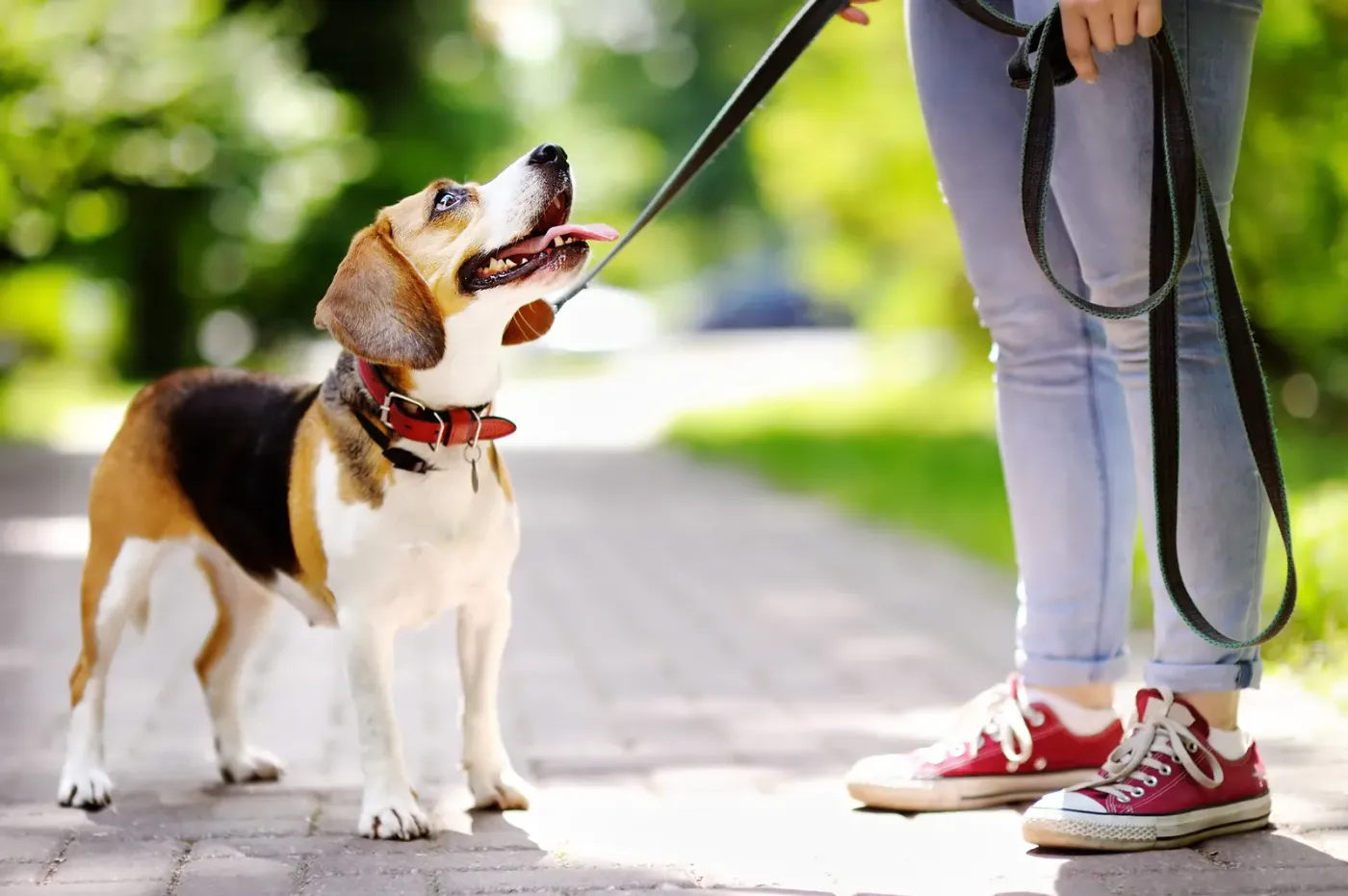
The most useful thing an owner can do is not interrupt. A tight leash pulls a dog into a straight-on approach, which can read as rude to the dog coming the other way. Give enough slack and space for your dog to arc, and step to the side yourself to make the curve easy. If your dog looks away and the other dog keeps pushing in, that is your cue to call yours back and move on.
People can borrow the same language. Approach a nervous dog side-on, avoid leaning over them, look slightly away and let them choose whether to come to you. When a dog's calming signals stop working and they shift to stiffening, freezing, growling or snapping, the encounter has gone past manners. Repeated escalation, or a dog who seems to have little calming vocabulary at all, is a good reason for a professional assessment.
Asked and answered
The questions people ask us.
What are calming signals in dogs?
They are subtle behaviours dogs use to lower tension, such as looking away, curving around another dog, slowing down or sniffing the ground. They help two animals get through a meeting without conflict.
Why does my dog sniff the ground when another dog approaches?
Often it is a polite way to slow the meeting and avoid direct eye contact. It may also simply be an interesting smell. Watch whether it happens right as another dog gets close and whether your dog's body stays loose.
Why does my dog walk in a curve toward other dogs?
Approaching in an arc is how many dogs greet politely, since a direct head-on line can feel confrontational. Leave slack in the leash so your dog can do it, rather than reeling them into a straight line.
Are calming signals the same as stress signals?
They overlap. A calming signal is aimed at someone else to defuse a moment, while stress signals reflect how the dog feels inside. The same head turn can be both, which is why context matters more than any single move.
Keep reading
Help your dog meet well
Book a consultation. We will watch how your dog greets, explain the signals in play and suggest the right level of support.
From real owners
Rated 5.0 on Google.
Real Northline dogs