
Breed trainability
Are Labradors easy to train?
The Labrador standard describes a kindly, outgoing, tractable dog bred to retrieve game for long hours. In our experience that reads as a dog that often takes to marker-and-reward work readily, and also as a dog built to work its nose and mouth all day. So our answer is that a Lab is often easy to teach and takes real effort to finish, mostly around food, greetings and the leash.
Last reviewed September 25, 2026
Teach versus finish
Learning a cue and leaving the sandwich are different skills.
The standard calls the ideal Labrador eager to please and tractable, and in our experience many Labs learn sit, down, place and a name response readily with markers and rewards. That is cue acquisition. It happens in a quiet room with nothing competing. It says little about what the same dog does when a bin lid is open, a stranger reaches out or another dog appears across the pathway. Those are performance questions, and each one gets practised on its own.
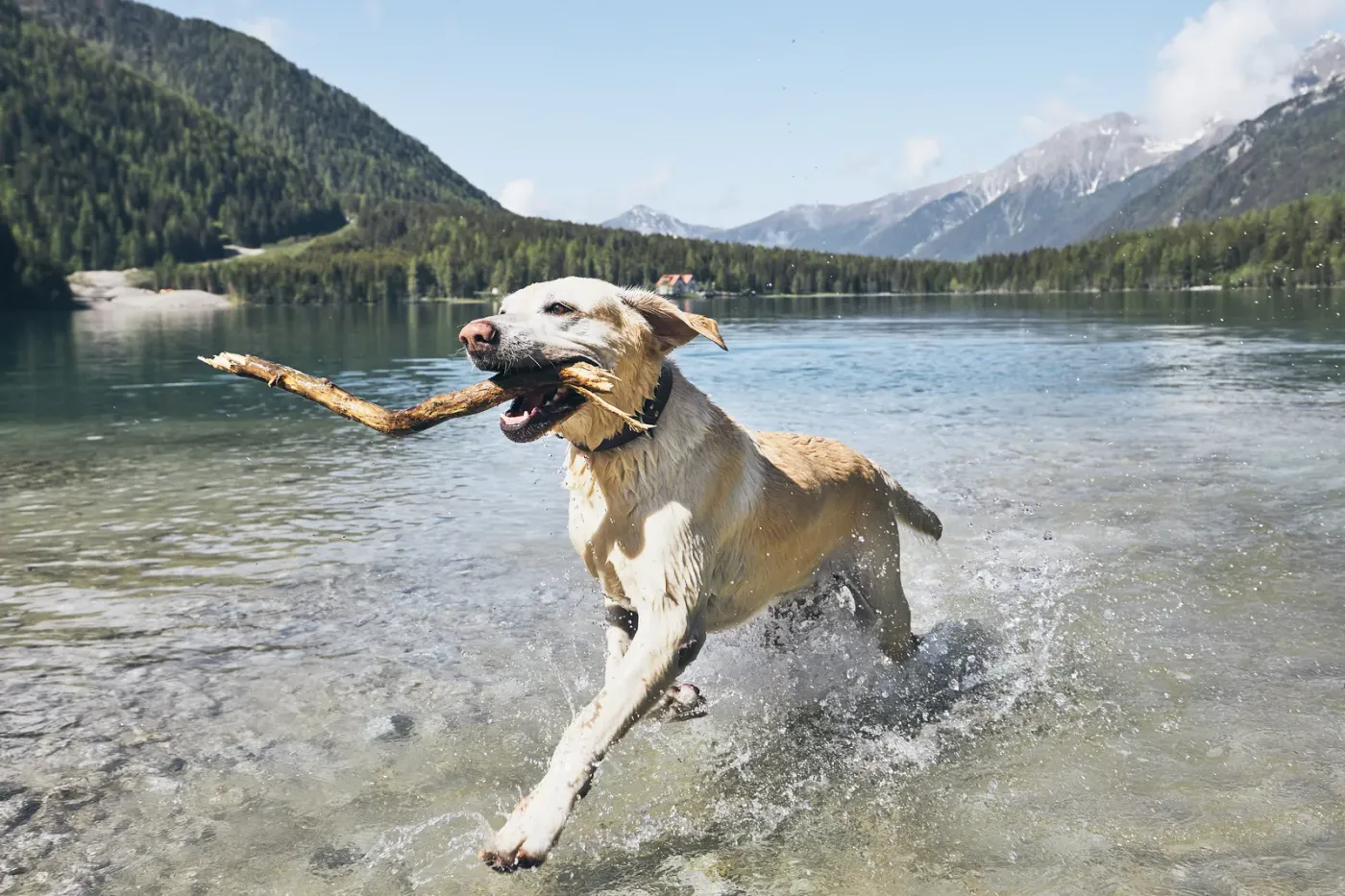
The finishing work, for many Labs, lands in three places. Accessible food: counters, open bins and whatever a river path offers, which makes leave it and drop it their own curriculum. The retrieving job the standard describes: a dog bred to carry game and enter cold water may find a thrown stick or a river more interesting than any pouch. And build: the standard calls the breed strongly built, and an adult Lab leaning into a collar is a lot of dog to hold.
- Cue learning often comes readily
- Leave it taught as its own skill
- Retrieving drive competes with treats
- Strongly built adult on the leash
Rewards and conditions
Choose the reward for the dog, then practise where it counts.
We start where the dog's interest already is: kibble for one Lab, a retrieve for another. Neither is a promise. A reward that works in the hallway is only a starting point, and the same cue then gets rehearsed with an open bin, a visitor at the door and a dog across the street, one condition at a time. If the reward stops working, we look at the setting first. When a Lab's weight is the question, we would ask a vet, not a trainer.
Puppy Fundamentals ($2,775 plus GST) is the three-week board and train built for puppies in their learning window. On-Leash Foundations ($1,865 plus GST) is the two-week board and train built for dogs who drag. Functional Off-Leash ($3,030 plus GST) is the three-week board and train built for dogs with decent manners ready for real freedom, and it includes an Educator remote collar taught to the owner. The consultation recommends one, and a smaller one when that is enough.
Asked and answered
The questions people ask us.
Are Labs easy to train?
In our experience many Labs learn cues readily, and the breed standard describes a tractable, eager-to-please nature. We would still treat leaving food, greeting calmly and walking on a loose leash as separate goals that each need their own practice. A Lab that knows sit has not necessarily learned to leave the bin alone.
Are Labrador Retrievers hard to train?
We would not call the breed hard to train, but we would not call any Lab finished after a few quiet sessions either. The work that takes longest, for many Labs, is performing a known cue with food on the ground or another dog in view. We practise those conditions on purpose rather than hoping they never come up.
Are Labs stubborn?
Stubborn is not a word we use much for Labs. In our experience a Lab that ignores a cue has often found something more interesting, or has never practised that cue in that setting. We change the setting and the reward before we call the dog stubborn.
Are Labradors good first dogs?
Many are, in our experience, because the standard describes a kindly, outgoing dog and that forgiving nature suits a new handler. We would plan for the finishing work anyway: leave it, drop it and a loose leash on a strongly built adult. A first-time owner who plans for those is planning for the actual dog.
Are Labradors food motivated?
Many are, and that is a large part of why the breed is often described as trainable. We would separate food interest from attention, though: a Lab that wants the treat can still choose the dropped sandwich. When food stops holding attention we look at the setting and the reward, and we leave weight questions to the vet.
Keep reading
Plan the finishing work.
Bring us the Lab and the bin lid story. Book a consultation; we will name a program, or a smaller one.
From real owners
Rated 5.0 on Google.
Real Northline dogs