Breed trainability
Are Australian Cattle Dogs hard to train?
A heeler was bred to move cattle by biting heels and to think for itself while doing it. Put that dog on a city lot in Calgary, next to a pathway full of cyclists and runners, and the same instincts get pointed at ankles, wheels and the kids' friends. The breed is not hard to teach. It is hard to leave unemployed. This page gives the straight answer on both.
Last reviewed September 25, 2026
Quick brain, busy mouth
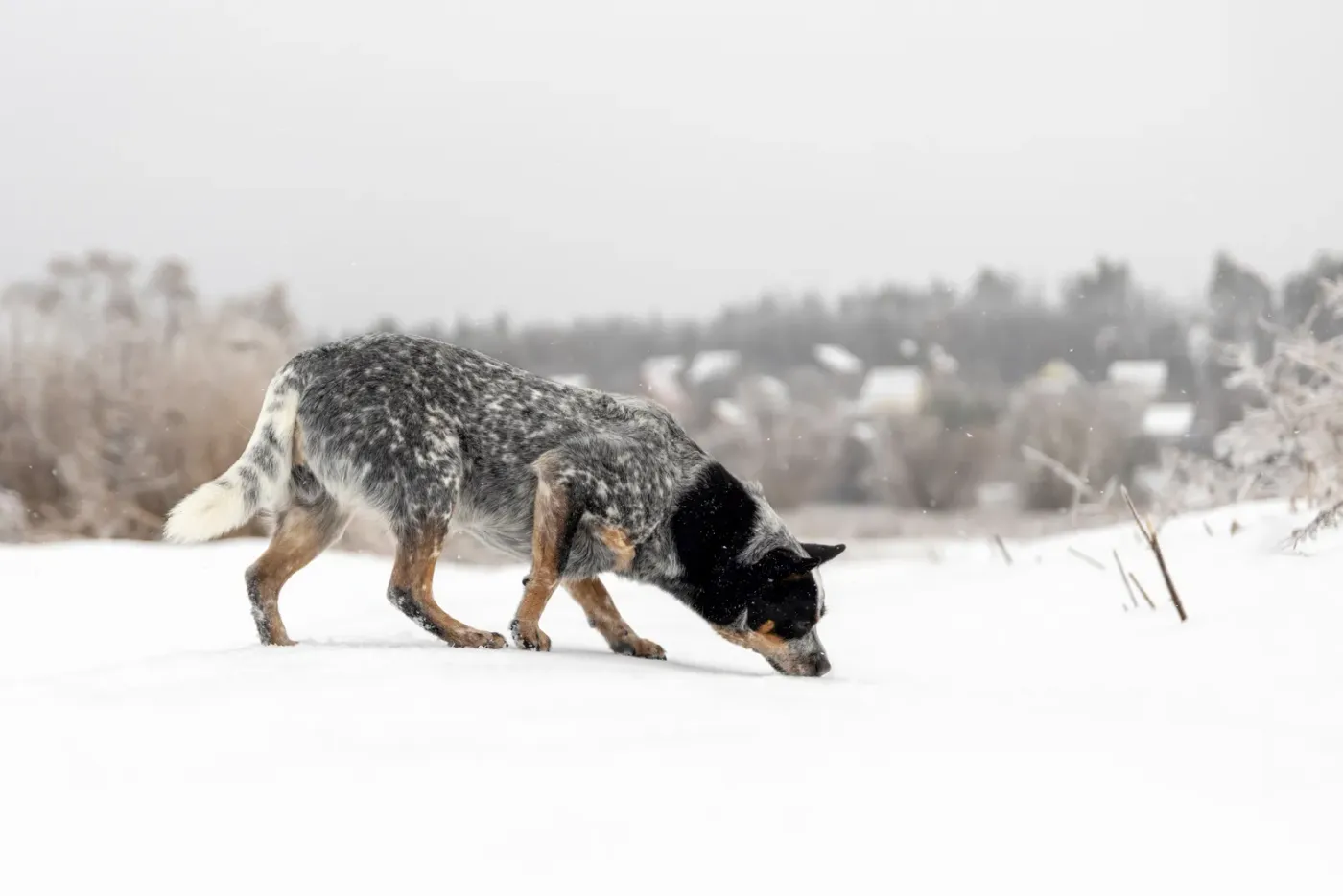
Fast to learn, faster to find its own job.
The easy side is genuine. A cattle dog picks up sit, down, place and heel in a handful of sessions, holds them under pressure, and wants more. Attention is rarely the problem. This dog watches you the way it would watch a herd, and it will work for a ball, a tug or a chance to do the next thing. If your idea of a hard dog is one that ignores you, a heeler is the opposite. It is waiting for instructions.
The hard side is what the dog does with an empty afternoon. Nipping at heels is not aggression, it is the job description, and toddlers, running children and pathway cyclists look like cattle that need moving. Left without work, a heeler appoints itself security, guarding one person and eyeing visitors. Management comes first: a leash near bikes, a crate or place when kids are running, and no chance for a nip while the alternative is still being taught. Growling is information, never something to punish.
- Learns commands in a few sessions
- Nips heels by job description
- Herds bikes, runners and kids
- Guards its people when unemployed
Give it work
Structure, outlet and a leash near the pathway.
At home, cattle dog training is less about new commands, more about an off switch and a job. We lean on place: a heeler that settles on a mat while the family moves around is not tracking ankles. Daily work means real tasks, not a walk alone: scent games, tug with rules, obedience sessions that make it think. On the pathway the dog stays leashed and heeling until passing cyclists mean nothing. A city lot cannot replace acreage, so the outlet has to be deliberate.
Program fit depends on whether the nipping is already a pattern. A young heeler with instincts but no incidents does well in the two-week Complete On-Leash Foundations program at $1,865 plus GST, where heel past distractions is the core skill. A dog already guarding a person or snapping at visitors is Behaviour Rehab territory, five to six weeks after a full assessment, $4,850 to $5,760 plus GST. A consultation looks at the household, any incidents so far, and how much work the dog gets.
Asked and answered
The questions people ask us.
Are Australian Cattle Dogs easy to train?
Yes, in the sense that they learn fast and love having a task. The difficulty is that an untrained heeler is also learning fast, just from the wrong teacher: the bike that ran away when it chased, the child who squealed when it nipped. Train early and the speed works for you.
Are blue heelers hard to train?
Blue heelers and red heelers are the same breed with different coats, and neither is hard to teach. What is hard is the management around nipping, herding and guarding while the training catches up. That is where most owners actually need help.
Are heelers stubborn?
Not usually. A heeler that ignores a command has typically decided the job in front of it, like a runner going past, matters more than yours. Clear rules, real outlet and consistent follow-through settle that argument quickly.
Are cattle dogs good family dogs?
They can be, with structure, daily work and adults who manage the dog around small children rather than hoping for the best. A heeler that has nipped a child or begun guarding one person needs a professional assessment, not more freedom. With those pieces in place they are loyal, sharp and devoted.
Keep reading
Put that brain to work.
Book a consultation to talk through the nipping, the pathway and the household before any program gets suggested.
From real owners
Rated 5.0 on Google.
Real Northline dogs