
Households
Dog training for older owners and limited mobility
Most training advice assumes a handler who can jog backwards, kneel on the kitchen floor and hold a lunging dog without going over. Plenty of owners cannot, whether from age, a hip, a bad back or a walker. We would not train the dog less for that. We would shorten the list, practise the seated parts from a chair, and be honest about which parts only happen on the move.
Last reviewed September 25, 2026
The short list
What can be taught sitting down, and what cannot.
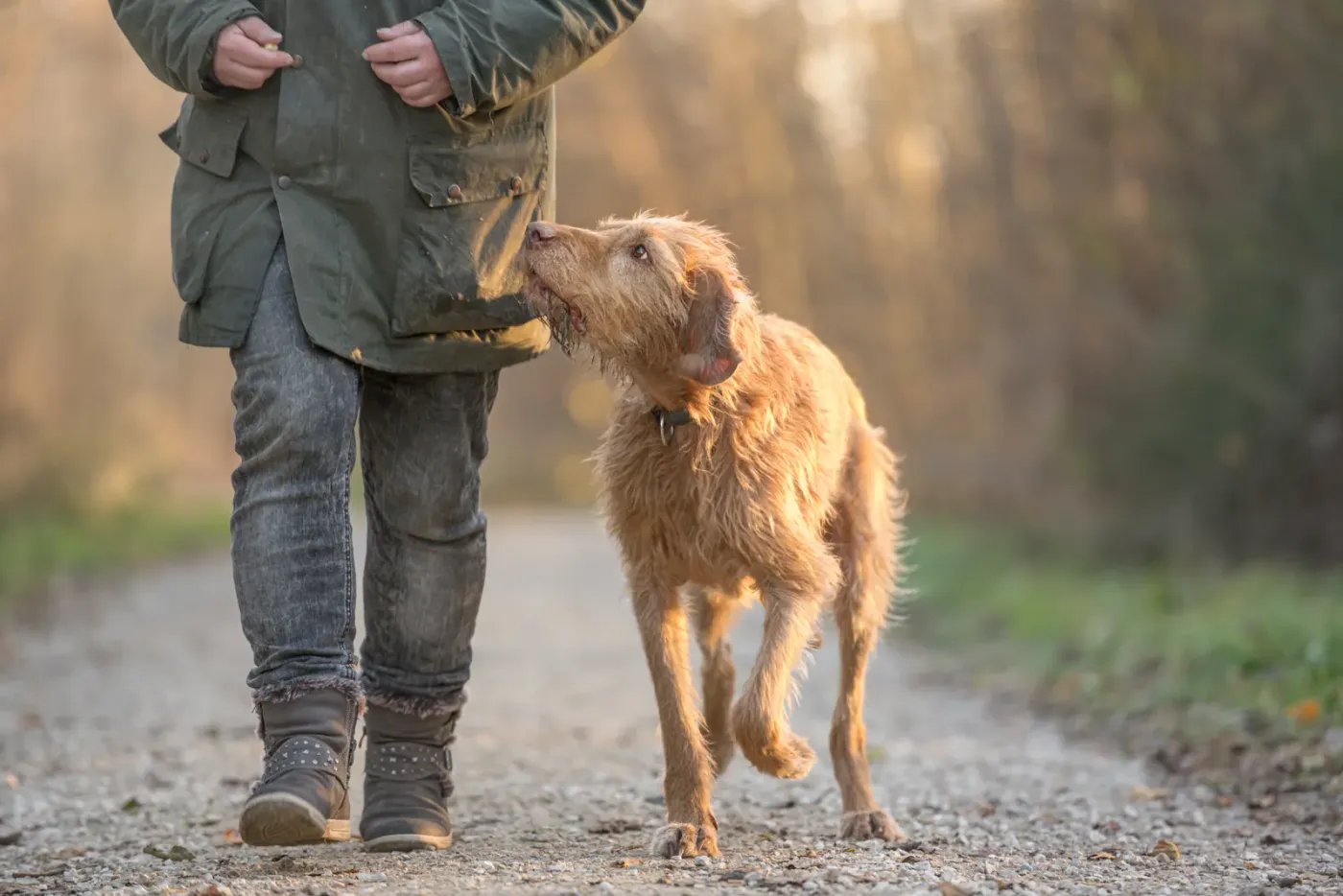
We start with the skills that keep a handler upright: a loose leash, four feet on the floor for greetings, a wait at every door so the dog is not bolting past a walker, and a settle on a mat. The stationary ones suit a chair. We recommend a short leash, a marker word, treats paid from a pouch at hip height, and letting the dog come to the hand rather than bending to it. Tossing treats to the floor cuts the reaching further.
Loose-leash walking is the exception. A dog that walks beside a chair has not learned to walk past another dog on a January sidewalk, and the sidewalk is what matters. We recommend building it on the move, somewhere quiet, with a second person nearby. Equipment is matched to the individual dog, but no slip lead or collar stands in for a dog that has learned not to pull, and no tool removes the risk of a fall.
- Loose leash before anything else
- Four feet down for greetings
- Wait at every door
- Reward from hip height
The practical route
Letting a program carry the repetitions.
When the walking part is more than a body can take on, board and train is one practical route: the dog lives with us and trains one-on-one daily. On-Leash Foundations is two weeks at $1,865 plus GST and works on loose-leash walking, heel, sit, stay, down, place and everyday distractions. It includes a handover lesson, a free follow-up session and a slip lead and training collar to take home. We recommend the program at the consultation, and the smaller one when it is enough.
No program changes the handover: the dog still has to walk on a loose leash for the person holding it, and that person still has to practise. We recommend telling us at the consultation what you can and cannot do, whether that is bending, bracing or walking on ice, so the recommendation fits your reach rather than an imagined handler's. If a doctor or physiotherapist has set limits, those come first. Winter sidewalks make the loose leash the priority.
Asked and answered
The questions people ask us.
Is there dog training for seniors that does not involve a lot of walking?
Yes. We would keep the seated skills, sit, down, place, a settle and a wait at the door, in short sessions from a chair, and let the marker and the treats carry the session. Loose-leash walking still has to be practised on the move, so we recommend a second handler or a program for that part.
My dog is pulling an elderly owner over. What should we do?
We recommend pausing any walk that risks a fall and treating the pulling as urgent rather than a habit to live with. On-Leash Foundations, two weeks at $1,865 plus GST, works on loose-leash walking and everyday distractions before the handover lesson. We would not rely on a collar or slip lead to hold a strong dog for a light handler.
What is the best way to train a dog when you can't walk far?
We suggest training in the driveway, the hallway and the living room in bursts of a few minutes, and letting markers and rewards do some of the work distance would normally do. Sniffing games and food puzzles at home fill in on the days distance is not an option.
Can you train a dog with limited mobility, or does the dog need to go away?
Both routes exist. Private Training at $150 plus GST per one-hour session comes with a written weekly plan built around what you can physically do, and Day Training at $650 plus GST per week keeps the dog home every night with a weekly one-hour go-home session. A board and train takes on the daily repetitions, and the consultation is where we recommend which fits.
Keep reading
Training that fits your reach.
Book a consultation and tell us what you can and cannot do. We will recommend the smallest program that fits.
From real owners
Rated 5.0 on Google.
Real Northline dogs