Before you book
Will my dog listen to me or just the trainer?
Weeks of training happen while the owner is somewhere else, so it is reasonable to wonder whose voice the dog will answer at home. The honest answer is that dogs respond to more than a word. They respond to a handler, a place and whatever else is happening, and each of those changes when the dog leaves us. This page is about those differences and the support that comes with every program.
Last reviewed September 28, 2026
Handler differences
A cue is more than the word, and the handler is part of it.
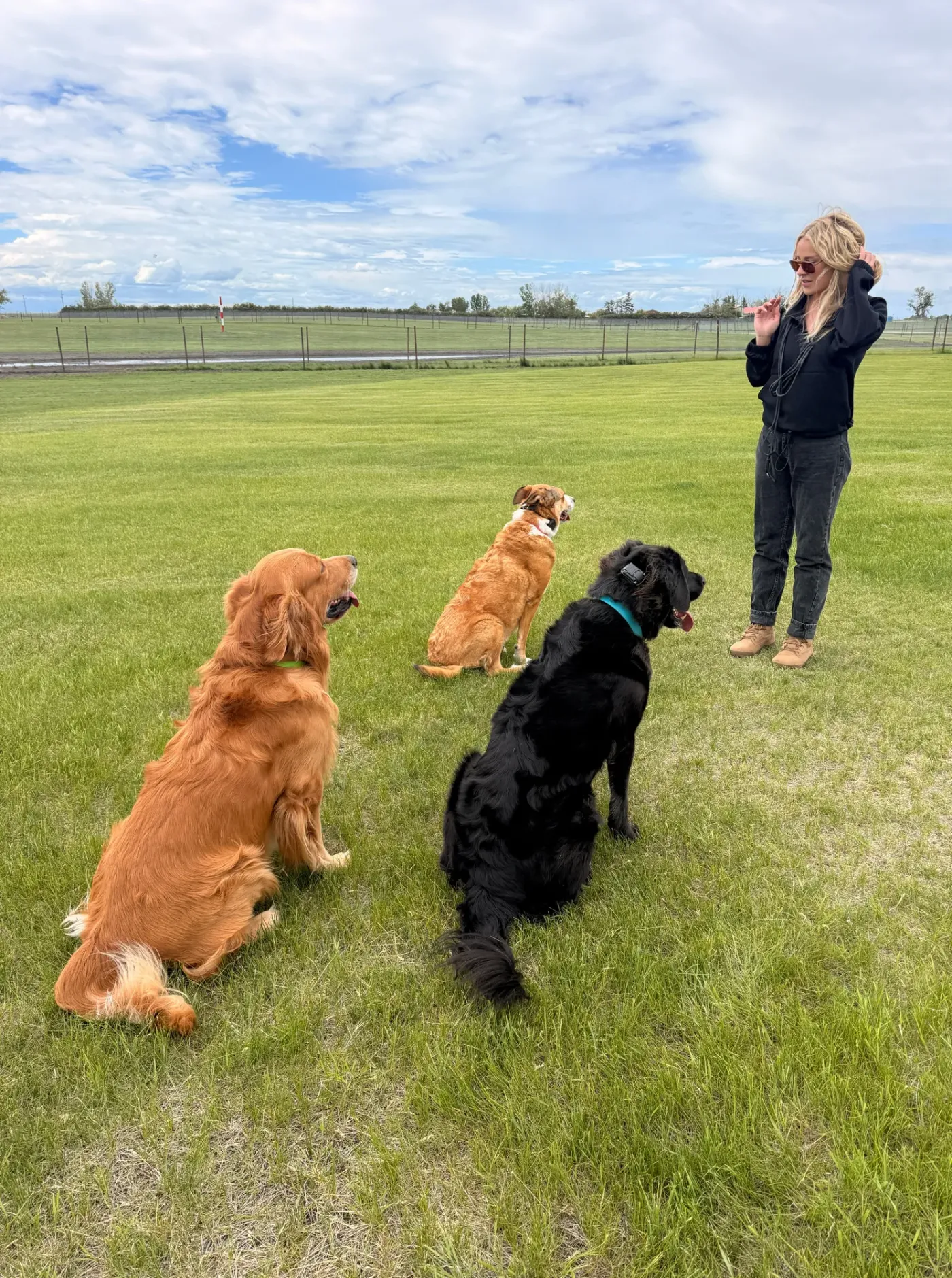
A dog tends not to store a cue under a person's name. It stores the whole event: the word, the tone, the hand, any leash pressure, the marker that follows and whatever arrives after that. When one part changes, the dog is, from its side, being asked a slightly different question. A new handler changes several parts at once: voice pitch, posture, timing, how long the pause is before help arrives. None of that is disloyalty. It is a dog noticing a difference.
Context matters too. A sit that holds in a quiet room is a different task at a front door with a visitor on the step, and a recall past a squirrel is a different task from a recall across an empty field. This is why every board and train proofs skills around real distractions, and why the handover lesson and free follow-up sessions exist. That is where handler differences get worked on.
- Same word, same tone
- Marker at the same moment
- Same follow-through after the cue
- Distraction level, then and now
Home practice
The switch to your voice has no fixed timetable.
We do not hand out a day count for when a dog will answer its owner the way it answers us, because dogs differ and so do households. What we can offer is a way to troubleshoot. When a cue that works for us does not work at home, the useful questions are neutral ones: was the word the same, did the marker come at the same moment, was anything different about the place or the distraction, and what followed the cue.
In our experience, households with more than one handler see more variation, for the plain reason that there are more versions of each cue in play. We do not treat that as anyone's fault. Different voices are rarely the problem; different rules for the same word often are. Agreeing on one word per behaviour and one response when the dog does not comply gives the dog fewer versions to sort through, and that agreement is worth making before the dog comes home.
Asked and answered
The questions people ask us.
Why does my dog listen to the trainer but not me?
Often because several parts of the cue changed at once: voice, timing, posture and what happens when the dog hesitates. Dogs tend to respond to that whole package, not the word alone. Comparing each part, one at a time, is a fair place to start.
Will my dog only obey the trainer after board and train?
We cannot promise identical responses across handlers, but the program is not designed to build obedience to one person. It is built to teach skills, then hand them over at the handover lesson and support them with free follow-up sessions. Where a response differs at home, those sessions are the place to work on it.
What if my partner and I use different commands?
Two words for one behaviour give the dog two versions to sort through, and dogs tend to cope better with different voices than with different rules. Choosing one word per behaviour before the dog comes home removes one variable. The handover lesson is a reasonable moment to settle it.
How long until my dog listens to me the way it listens to the trainer?
There is no fixed number, and we will not invent one; it varies with the dog, the household and how closely the cues match. The free follow-up sessions included with every board and train are where a cue that works for us and not at home gets looked at.
Keep reading
Your voice, their cues
Book a consultation and we will explain which program fits, what it includes, and how the handover and follow-up sessions work.
From real owners
Rated 5.0 on Google.
Real Northline dogs