
Straight answer
Why does my dog pull on the leash?
Every dog that drags its owner down the block is running the same simple economy: tight leash, step forward, payment received. Nothing about it is stubbornness or dominance. It is a fast animal being paid, over and over, to tow a slow one. Once you see the transaction clearly, the fix stops being mysterious, and the equipment aisle stops looking like the answer.
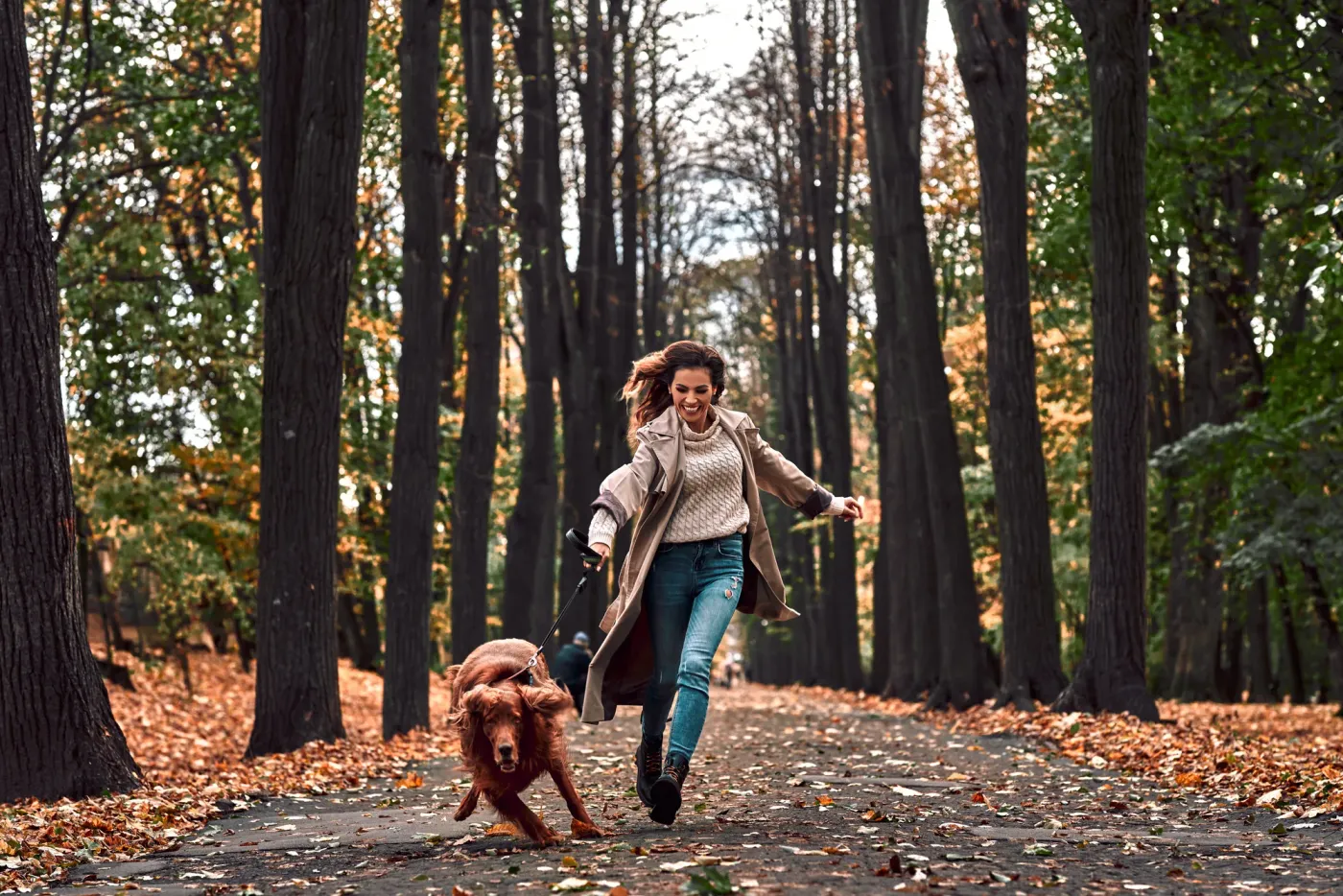
The pulling economy
Pulling gets paid on every walk.
Start with pace. A comfortable trot for most dogs is quicker than a brisk human walk, so from the dog's side, you are permanently lagging. Ahead of them sits everything worth having: smells, other dogs, the park itself. When the leash goes tight and you keep walking anyway, the dog reaches all of it sooner. Pulling is not defiance. It is the strategy the walk itself has been rewarding since day one.
There is a mechanical layer too, called the oppositional reflex: when a dog feels steady pressure against its chest or neck, its instinct is to push into it, the same reflex that keeps it upright when shoved. That is why hauling backward makes most dogs lean forward harder. And when the prize is another dog across the street, arousal joins the equation, which is when pulling turns into full sled-dog commitment.
- Forward motion rewards pulling
- Dogs naturally outpace humans
- Pressure triggers pushing back
- Excitement multiplies the force
The actual fix
Equipment manages it, training changes it.
Harnesses, head halters, and no-pull gadgets all share a limitation: they change the leverage, not the lesson. A front-clip harness makes pulling less efficient, and the dog pulls less efficiently forever after. The economy underneath is untouched, which is why the pulling returns the moment the equipment comes off. Tools have a place in our training, but as teaching aids with an exit plan, never as the fix itself.
The cure has two halves, and both are required. First, pulling stops paying: a tight leash now means forward motion ends, every single time. Second, position starts paying: walking at your side gets marked and rewarded until the heel becomes the profitable spot on the walk. We break the step-by-step method down in our loose-leash walking guide, and we teach it in every program, from Puppy Fundamentals to Complete On-Leash Foundations.
The programs
Walks, fixed professionally.
If the method above needs more hands, these formats rebuild the walk with us.
Asked and answered
The questions people ask us.
Why does my dog pull so hard on the leash?
Force builds because pressure invites counter-pressure: the oppositional reflex makes a dog lean into a tight collar rather than yield to it. Combine that with excitement about whatever is ahead and years of pulled steps that worked, and you get serious horsepower. Hard pulling is a well-practised habit, not a character flaw.
Why does my dog pull towards other dogs on walks?
Other dogs are the highest-value thing on most walks, so the pull toward them is the strongest. If the greeting sometimes happens, the habit gets paid just often enough to stay strong. The fix is the same economy applied at higher stakes: pulling ends progress, calm walking earns it.
Will my dog grow out of pulling on the leash?
No, dogs grow into it. Every walk where pulling moves the walk forward makes the habit stronger and the dog better conditioned at it. Waiting usually means retraining a larger, more committed athlete later.
Does a no-pull harness stop a dog from pulling?
It reduces the efficiency of pulling, which feels like improvement, but it does not teach the dog anything about where to walk. Most dogs pull against front-clip harnesses indefinitely, just with less power. Training changes the behaviour; equipment only changes the physics.
Keep reading
End the towing career
Loose-leash walking is teachable at any age. Book a consultation and we will match your dog to the right program.
From real owners
Rated 5.0 on Google.
Real Northline dogs