
Breed trainability
Are German Shepherds easy to train?
German Shepherds have a reputation as the easy breed, and it covers only part of the job. In our experience many pick up cues quickly and keep them. The questions that usually matter more are different: the barking along the fence, the charge at the front door, the fixation on a cyclist passing on the pathway. Those are separate skills with more than one possible cause, and this page takes them one at a time.
Last reviewed September 25, 2026
Cues versus context
Learning a cue and staying calm at the fence are different skills.
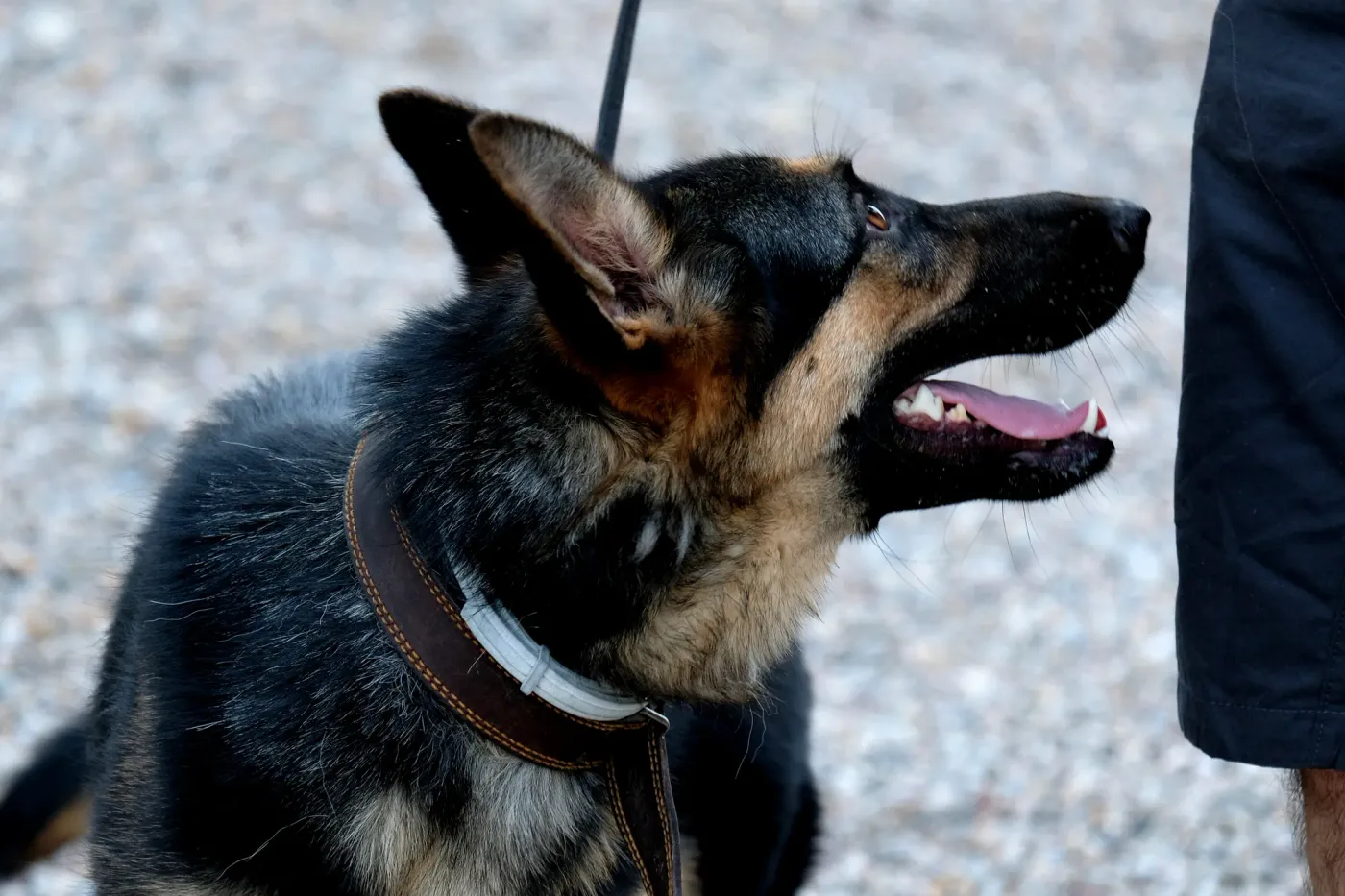
Cue learning is where the easy reputation comes from. A German Shepherd often connects a marker to a reward within a few repetitions, stays engaged with a handler, and holds a down or a wait once it understands the picture. We use rewards for this, because paying a dog for the right choice is how the choice gets repeated. Individuals vary: some are softer and more sensitive to tone than the reputation suggests, so we adjust to the dog we are working with.
The harder questions sit in context, not in the cue. Barking along the fence, rushing the front door, and locking onto a cyclist or jogger on a pathway are each learned in a particular spot, and none has a single cause. Breed background may play a part, since the breed is often described as watchful and reserved with strangers. So may the dog's history, health, age and what happened there before. We look at the situation rather than assuming the dog is under-worked.
- Cues often come quickly
- Fence barking is a separate skill
- Doorway rushing has several causes
- Pathway fixation judged case by case
Neutrality and program fit
Teaching a Shepherd to watch the world go by without joining in.
Much of the useful work with this breed is neutrality: the dog sees the cyclist, the visitor or the neighbour's dog and chooses to stay with its handler. We build that with a marker and reward for looking and then disengaging, at a distance where the dog can still think, and we shrink the distance only as the dog succeeds. Place at the door gives the dog somewhere to be when the bell rings. Progress depends on the dog and its history.
Puppy Fundamentals is a three-week board and train at $2,775 plus GST, built for puppies. On-Leash Foundations is a two-week board and train at $1,865 plus GST, built for dogs that pull. Behaviour Rehab is a five to six week board and train for anxiety, reactivity and aggression, $4,850 to $5,760 plus GST after a full assessment. All are one-on-one, with a handover lesson and free follow-up sessions. A consultation recommends the program, including a smaller one when it is enough.
Asked and answered
The questions people ask us.
Are German Shepherds hard to train?
Not usually in the cue-learning sense; in our experience many pick up new behaviours quickly. The harder projects are the ones tied to a place or a trigger, such as barking along the fence or fixating on passing cyclists, and those can have several causes. We assess each one rather than assuming the dog needs more work.
Are German Shepherds stubborn?
In our experience stubbornness is seldom the useful explanation. A Shepherd that ignores a cue at the fence but performs it in the kitchen has usually learned the cue in one setting only, or is too aroused to respond. Practising in calmer settings and paying well for the right choice is where we start.
Are German Shepherds good first dogs?
They can be, and the honest answer depends on the household as much as the dog. A large, attentive dog that is often reserved with strangers benefits from early, deliberate socialization and daily practice, and its size makes leash skills a safety matter on Calgary pathways. Private Training, at $150 plus GST for a one-hour session with a written weekly plan, suits owners who want to do that work themselves with guidance.
Are GSDs easy to train?
Often yes for cues, and individuals vary more than the reputation suggests: some are softer and more sensitive to tone, others more driven. We adjust the pace and the rewards to the dog. A dog that learns quickly also picks up unintended patterns, so we are careful about what gets paid at the door and the window.
Keep reading
Walk us through your Shepherd's day
Book a consultation. Describe the fence, the door and the pathway. We will recommend the program that fits, smaller if that is enough.
From real owners
Rated 5.0 on Google.
Real Northline dogs