
Breed trainability
Are Dobermans easy to train?
Many Dobermans are attentive learners: they tend to watch the handler closely and often pick up new cues without much repetition. We find the harder questions come later, and they are rarely about obedience. Here is where we land, including how the breed's closeness to its people, its reactions to strangers, and a Calgary winter with a short coat all shape the training.
Last reviewed September 25, 2026
Quick and close
Sharp in the lesson, sensitive everywhere else.
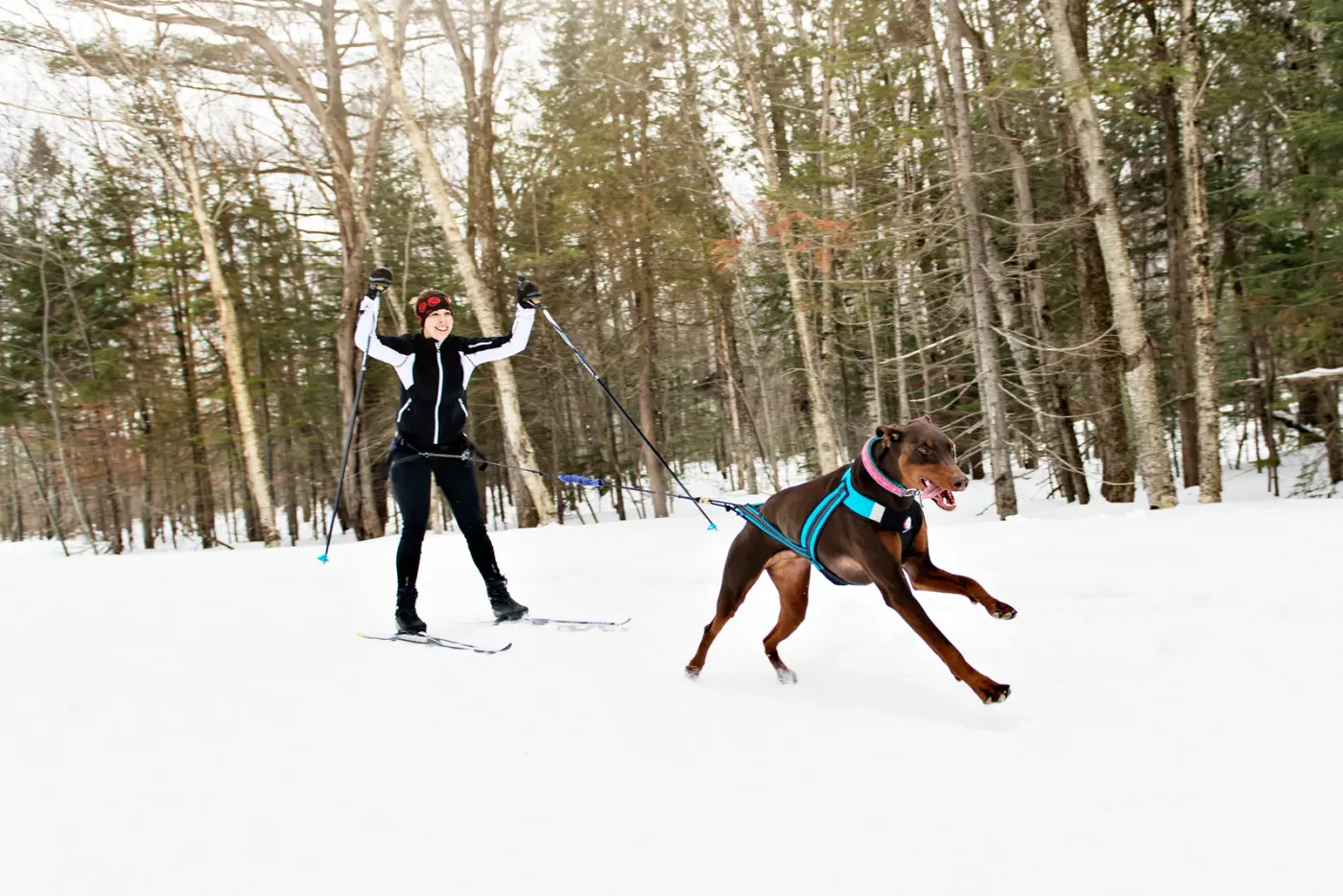
Dobermans were bred as personal protection dogs, and many carry the traits that suited the role: physically fast, mentally quick, and closely tuned to their person. In our experience, many are also sensitive, so a heavy-handed correction tends to land harder than it might on a thicker-skinned dog. Some prefer to be near their handler at all times, sometimes underfoot. Teaching heel, down, stay and recall to a dog like that is often straightforward, which is where the easy reputation comes from.
The harder part is what the dog does with strangers and with a leash. Some Dobermans are wary of people at the door or approaching on a pathway, and some get aroused on the leash and lunge at whatever moves. We would not assign one cause to that; several different dogs can look the same from the sidewalk. A Calgary cold snap adds a problem: a short-coated dog often needs a coat and shorter outings, so part of the work has to happen indoors.
- Indoor work on cold-snap days
- Gentle handling, clear timing
- A door routine for strangers
- A coat for short winter walks
Routine and fit
Structure for the day, honesty about the cause.
At home, we suggest giving a Doberman something to do each day before asking for calm: a structured heel, a scent game in the basement when the sidewalk is too cold, or a few minutes of obedience for food. That is a routine, not a cure, and we would not expect work alone to settle an anxious dog. Strangers at the door get a place command and a set sequence, so the dog has a rule to follow rather than a decision to make.
On-Leash Foundations is a two-week board and train at $1,865 plus GST, built for dogs who drag or lunge on the leash. Functional Off-Leash is a three-week board and train at $3,030 plus GST for recall around distractions, with an Educator remote collar included. Anxiety, reactivity or aggression belongs to Behaviour Rehab, a five to six week board and train at $4,850 to $5,760 plus GST, customized after a full assessment. The consultation decides which fits, and a smaller program when it is enough.

Asked and answered
The questions people ask us.
Are Dobermans hard to train?
Not usually in the sense of learning cues, since many are attentive and quick to pick things up. What we find harder is raising one well: a daily routine, early structure around strangers, and honest attention to any anxiety rather than assuming exercise will fix it. None of that runs on a fixed timeline.
Are Dobermans stubborn?
Stubborn is not a word we reach for with this breed, and we would not label a dog for ignoring a cue. In our experience a Doberman that stops responding is often over-aroused or worried about something in the environment. We would look at what changed before asking for the cue again.
Are Dobermans good first dogs?
For a first owner with time and a steady daily routine, we think so. We would be cautious for a first owner hoping the dog will entertain itself in the yard, since a strong, attentive dog with nothing to do can find its own projects. Book a consultation before the puppy arrives when in doubt.
Are Dobermans easy to train off leash?
Many take to recall work readily, though we would prove it around real distractions before trusting it. A fast dog with a half-trained recall can cover a lot of ground quickly, so we treat proofing as the point of the program. Functional Off-Leash is our three-week board and train at $3,030 plus GST, with a Micro or Mini Educator remote collar and owner education on using it included.
Do Dobermans do well in Calgary winters?
Many manage with a coat and shorter outings in a cold snap, and a vet can advise what a particular dog tolerates. We suggest moving part of the daily routine indoors on the coldest days rather than skipping it.
Keep reading
Structure for a sharp dog.
Tell us the dog's daily routine and how it greets strangers. Book a consultation and we will take it from there.
From real owners
Rated 5.0 on Google.
Real Northline dogs