
Breed trainability
Are Boxers hard to train?
A Boxer will often learn the command and then struggle to hold it, because a greeting is happening and the greeting wins. That is the breed as we usually meet it: clever, affectionate and slower to settle than to learn, though individuals vary a lot. Add a Calgary sidewalk in February, where a jumping dog can take a person down on the ice, and impulse control stops being optional.
Last reviewed September 25, 2026
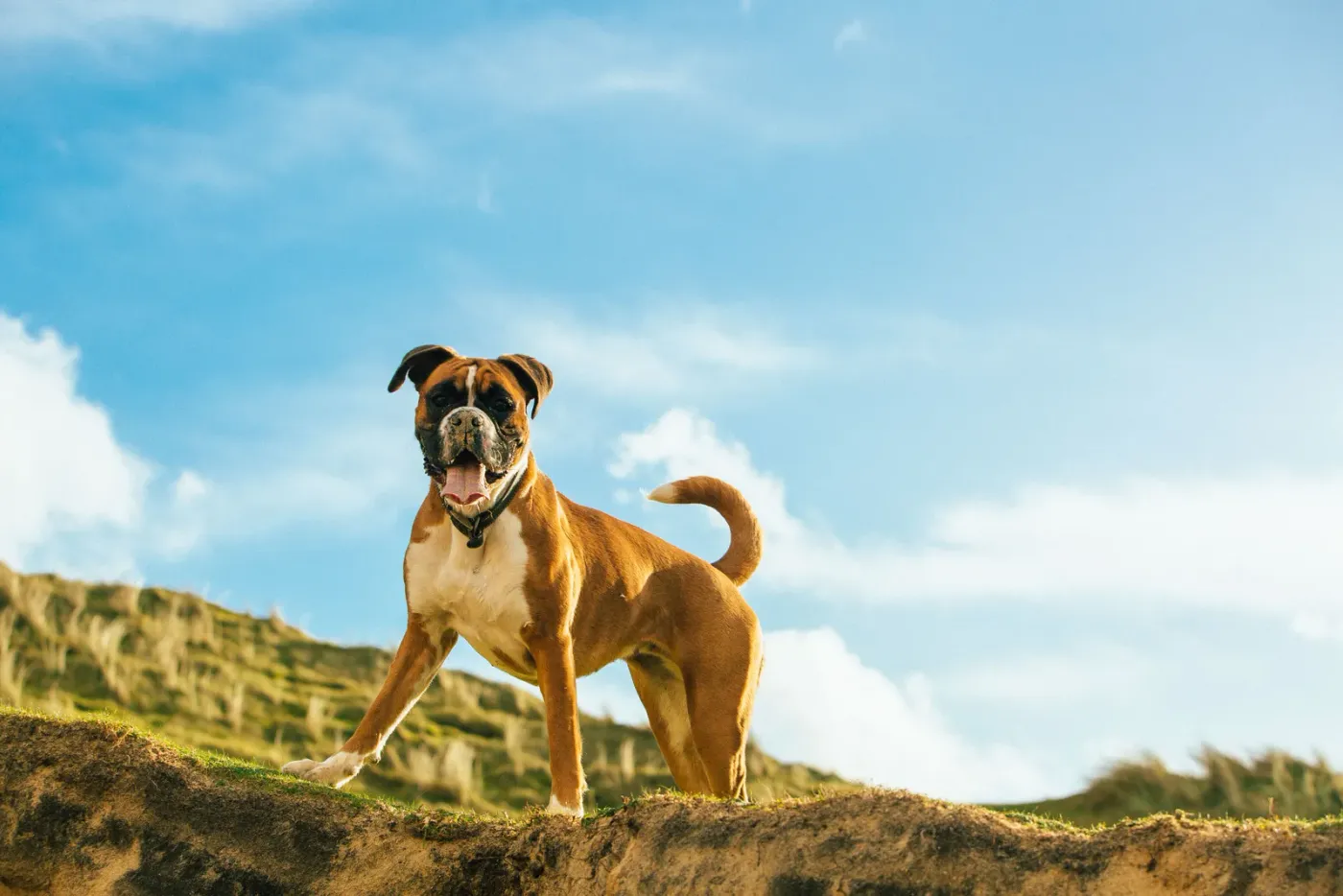
Playful and mouthy
Quick to learn, slower to stay still.
Many Boxers are easy to teach in the narrow sense. In our experience they tend to be people-focused, playful and willing to work for food, so a marker and a treat often get a quick sit and down and a dog that lights up when the training bag comes out. Holding that sit while a visitor walks in is a different skill, and it is the one that takes the hours. The size of that gap is individual.
Mouthiness is common in the breed, though not universal, and we take it seriously. Many Boxers greet and play with an open mouth, and an overexcited one may grab a sleeve; our answer is to redirect to a toy, reward a closed mouth and end the greeting when teeth appear. Adolescent jumping and barging can also last longer than owners expect. We read that as arousal rather than defiance, and arousal is what we train with structure and repetition.
- Often playful, food-motivated learners
- Mouthy greetings are common
- Holding positions takes the hours
- Arousal, not defiance
Impulse control
Calm greetings, doorway pauses, and the program to match.
At home, Boxer training looks less like teaching commands and more like teaching pauses. A place command with long duration, a sit that holds while the door opens, a loose leash when a friend appears: each one is a rep for calm. On winter sidewalks, four feet on the ground is a safety rule, because a jumping dog on ice can pull a person over. Cold snaps often shorten walks for a short-coated dog, so indoor impulse-control games have to carry some of the load.
For a Boxer that pulls toward every greeting, On-Leash Foundations is a 2-week board and train at $1,865 plus GST covering loose-leash walking, place and stay around everyday distractions. Puppy Fundamentals, a 3-week board and train at $2,775 plus GST, covers crate comfort and structured socialization for a young pup. Functional Off-Leash, $3,030 plus GST over three weeks, works on recall around distractions, with an Educator remote collar included. Which program fits, and whether a smaller one covers it, is a consultation question.
Asked and answered
The questions people ask us.
Are Boxers easy to train?
Easy to teach, in our experience, yes. Many Boxers pick up new commands quickly and enjoy the game. The part that takes real work is holding a position when something exciting happens, and that is where the training hours go.
Are Boxers stubborn?
We do not see it that way. A Boxer that seems to ignore a cue is often mid-greeting, with all four feet and the whole tail committed to saying hello, and holding a position in that state is a skill it has not been taught yet. We build that skill with duration on place and pauses at doorways, then bring in the excitement gradually.
Are Boxers good first dogs?
They can be, for a first owner who enjoys an energetic, physical dog and is ready to train impulse control as an ongoing habit rather than a short project. How long the bouncy phase lasts varies from one Boxer to the next, so we do not put a date on it. We would rather set up doorway pauses and calm greetings from the first week than backfill them later.
Can Boxers be trained off leash?
Many can, once the on-leash work is genuinely solid, and many Boxers seem to enjoy it. Functional Off-Leash ($3,030 plus GST, three weeks) works on recall around distractions, with the Educator remote collar included. Advanced Off-Leash ($3,940 plus GST, four weeks) adds off-leash heel, distance commands and public manners, with two follow-up sessions.
Keep reading
Stillness is trainable.
Tell us your Boxer's age and what sets off the bouncing. Book a consultation and we will match the program to the dog.
From real owners
Rated 5.0 on Google.
Real Northline dogs